
Tredegar in south Wales is more than 150 miles from Tufnell Park in north London. Neil Kinnock – who led the Labour Party between 1983 and 1992 – was born in the former and now lives in the latter. Kinnock is one of the last living members of a generation of Labour politicians whose political identity is inextricably linked to the valleys of south Wales. His Tory critics called him the “Welsh windbag”. But they always knew where he came from.
On a breezy spring day in early April, I met Kinnock for a drink at a pub close to his home. He spoke with a twinkle in his eye, peering through rimless glasses, and dressed in a handsome, deep-green tweed suit. Sat around a wooden table, lit up by hazy light from the fading spring day outside, I asked him about Wales. On 7 May, Kinnock’s home country faces a historic election. If the polls are to be believed, a century of Labour hegemony in Wales could be ended in one night. A YouGov poll from 21 April suggested Welsh Labour could win just 13 per cent of the vote, behind Plaid Cymru and Reform, who are both on 29 per cent.
Kinnock doesn’t like the description of Wales as a Labour “heartland”. It invites a sense of complacency, he told me. Though he will not be drawn on what might happen in May, the defiance that accompanies party leadership still runs through him (“we’ve got to fight to win”). But Kinnock is not under any illusions about the challenge his party faces. He described the political outlook in Wales as being driven by “a sense of grievance and resentment arising from the widespread feeling of being left behind”.
There is a widespread view that it is Kinnock’s own party that has been complacent. Welsh Labour has been in power in the Senedd for 27 years. Yet in 2026, the air of quiet confidence that once defined Cardiff Bay has become stagnant. In Wales, NHS waiting lists remain high, child poverty is rife, and there are only remnants of the nation’s proud industrial past left. The frustrated electorate no longer sees Welsh Labour as its natural party of government. In a few weeks’ time, it is almost inevitable that the people will vote for change.

If recent British history is a story of managed decline, Wales has been its worst victim. The twisting fortunes of time are symbolised by the 2,000 coal tips that still litter the valleys of South Wales. Coal was the fuel of Britain’s empire. It transformed idle dreams of conquest into railways, cities and fleets. Welsh coal was the Saudi crude of the 19th century. The tips are physical reminders of a missed opportunity to protect Wales’s post-industrial future. Instead, its economy has been drained and lags behind other parts of the UK: the employment rate in Wales remains the lowest of all four nations, while its economic inactivity rate (24.8 per cent) is the highest in Great Britain. Wales’s health and education systems are also underperforming. A report by the Institute for Fiscal Studies (IFS) ahead of 7 May found that waiting times in the Welsh health service are higher than those in England or Scotland. And gaps in educational attainment between Welsh pupils and English pupils have increased in recent years.
Young people are leaving in their droves. Wales consistently suffers a net loss of people between the ages of 18 and 24. In some Welsh towns and cities, the consequences of this are stark. Last year I visited Port Talbot, where the closure of the blast furnaces at the Tata Steelworks in September 2024 led to the loss of 2,000 jobs. Wandering around the town centre, I felt outnumbered, one of only a few young people among a throng of retirees. Port Talbot was once a bustling industrial town – and home to the largest steelworks hub in Europe – but in 2025 it felt exhausted and empty.
In the town’s dilapidated shopping centre, I met Jack Harper, a former employee of the steelworks, who at the time was working with Community Union to assist redundant steelworkers with the transition after Tata’s announcement. (As of April 2026, Harper no longer works for the union.) Among empty shopping units, a branch of Costa Coffee and a Poundland, insignia from the steelworks was displayed proudly: a banner hung from an upstairs balcony that read “Britain. We need our steel NOW!”
“The majority of people here are broken,” Harper told me. The decline and eventual closure of Tata Steel at Port Talbot was long and painful. Rumours of the blast furnaces closure began in September 2023. Following tense negotiations with the unions, the final furnace at Port Talbot closed on 30 September 2024. Steel was core to the town’s identity: there has been a steelworks in Port Talbot almost since it first appeared on a map. Construction on the plant began in 1901, the year after Keir Hardie – grandfather of the Labour movement – was elected as the MP for Merthyr Tydfil in the South Wales valleys in 1900.
Generations of Port Talbot residents passed through the steelworks: as Harper told me, some of those who lost their jobs following the blast furnaces closure had been working in the steel industry for 40 years. Though the Tata plant remains (it is being turned into an electric arc furnace), its relationship with the town has been profoundly changed. The change caused a lot of “distress”, to the town and its residents, Harper said. The plant’s younger workers have moved elsewhere, some emigrating as far as Australia to find work and build a new life.
Among the young people who have remained in Wales, there is a growing sense of disillusionment. In the centre of Cwmbran, South Wales, I met Saphia, a young woman in her twenties, working on an outreach stall for Costco. Cwmbran is one of 14 new towns built by Clement Attlee’s Labour government between 1946 and 1950. It was founded to provide new employment opportunities, outside of mining, for residents of the south-east Wales coalfield. Today its residents are mainly employed in retail and healthcare. Though the 1960s concrete shopping centre was bustling, Saphia appeared to be one of the youngest people there. She is local to the area. Torfaen Council, which covers the town of Cwmbran, was the first local authority in Wales to see the election of a Reform councillor in February 2025.
When I asked how she felt about the upcoming Senedd election, she immediately shot back: “I don’t vote.” Her logic was that even if she did back a specific candidate or party, decisions about her future would be taken in Cardiff Bay or Westminster – her vote would barely count. Saphia seemed to resent politicians, believing that many of them are paid “massive bonuses that they don’t deserve”. She clearly doesn’t feel listened to, and as a result has opted out of the system entirely. Saphia is far from alone. According to the Electoral Commission, more than half of young voters in Wales don’t believe voting in the upcoming Senedd election would lead to real change.
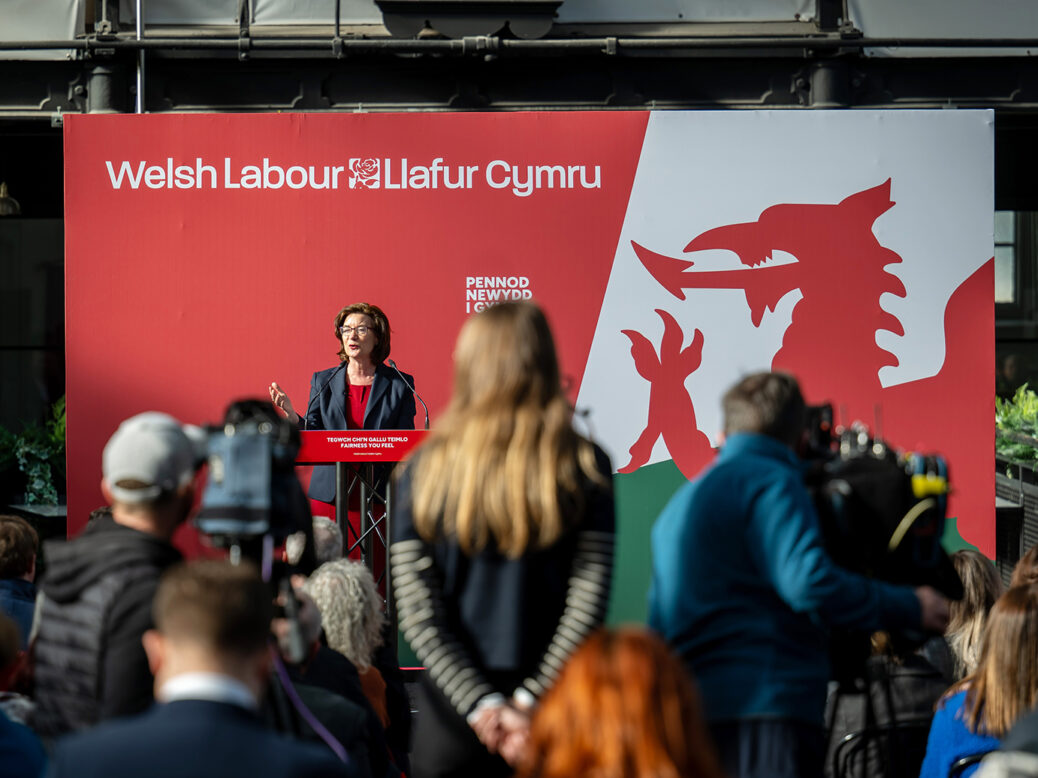
Welsh Labour is seen as the party of stagnancy. At the end of March, I travelled to Swansea for the launch of the party’s manifesto. There I met Eluned Morgan, the First Minister of Wales, a 59-year-old former member of the European Parliament and member of the House of Lords (she has been on a leave of absence from the Lords since she was elected to the Senedd in May 2016). Morgan has Welsh Labour in her blood. Her father was the leader of South Glamorgan County Council and a vicar on one of the largest housing estates in Europe, Ely in Cardiff, where she grew up.
Announcing her manifesto, Morgan urged Welsh voters not to vote for “change for change’s sake”. Welsh Labour’s manifesto tagline instead proposes “a new chapter for Wales”. It includes a freeze on income tax, a £2 cap on bus fares and £4bn spending over ten years on new hospitals (a proposal which the IFS suggested will only increase the squeeze on future day-to-day budgets).
When I pointed out that the polls suggest Wales seems intent on voting for change, she bristled. “I think there will be change, I want to see change,” she said. “I think we’ve constantly got to be changing.” Yet she also argued for the status quo, suggesting that voters should stick with Welsh Labour because the leaders of other parties have “literally no experience of running public services in Wales”. Kinnock’s warning of complacency echoes: Welsh Labour may be the most experienced in the field, but nor has it used that experience to turn things around for the people of Wales.
Mark Drakeford, Morgan’s predecessor as first minister, softly watched her speech from the wings. When I spoke to him shortly after Morgan had spoken, he seemed resigned to Labour being cast out of government on 7 May. Drakeford has been a key figure in the expansion of Welsh devolution. Long before he became first minister, he was a senior adviser to Rhodri Morgan, the first person to serve as first minister.
Drakeford recognised that “‘time for a change’ is one of the most potent slogans in politics”, and “every time you win an election, the hill gets a little bit steeper”. Perhaps he’s able to be more honest than Morgan – he will step down after the election. Drakeford sees his party’s future based in “a progressive group in the next Senedd”, which could mean a coalition with Plaid Cymru and the Greens, to keep Reform out – a suggestion Reform described as a way to stop “real people from having a seat at the table”. But would Plaid and the Greens agree to such an arrangement?
If the polling is to be believed, Plaid Cymru – the party of Welsh nationalism – looks likely to form the largest party in the Senedd for the first time on 8 May. Rhun ap Iorwerth, the towering, thickset leader and a former BBC Wales journalist, looked confident as he announced his party’s manifesto in Wrexham on 9 April, making half of his speech in Welsh. Ap Iorwerth is preparing himself for government. He said Plaid’s manifesto sets out a “level of ambition never seen in Wales before”. The party plans to introduce a Welsh child payment (a weekly £10 per child top-up to families’ universal credit), expand free school meals to more secondary school pupils and, perhaps most controversially, set up a commission into the feasibility of Welsh independence.
Should ap Iorwerth be elected on 7 May, he will be the first ever non-Labour first minister. Work has been going on behind the scenes to ensure the party is ready for government. But there have been snags: the IFS raised questions over how Plaid plans to fund its manifesto pledges. Considering the measures introduced to tackle child poverty, the institute notes that Plaid Cymru has provided “little information on how they would pay for these increases”. Even so, for voters fed up with Welsh Labour, Plaid Cymru seems to offer an alternative for progressive voters who would never choose Reform.
The Welsh Greens are feeling equally buoyant, even though the party doesn’t have a single Senedd member. A year ago, getting the party’s leader Anthony Slaughter elected in Cardiff Penarth was the top priority. Now, polls suggest the party could win a whole group of Senedd members, mimicking the success of the Greens nationally by taking voters from Labour’s urban-graduate base. At the time of writing, no discussions over a possible deal between Plaid Cymru and the Greens have taken place. Instead, the two parties are exchanging backhanded briefings over which party is the most “left wing”.
Privately, Plaid Cymru insiders have warned against the prospect of an eventual coalition. They fear encouraging potential Plaid Cymru voters to vote Green instead, who will then let in Reform under the supposition that a progressive government in the Senedd is a done deal. One Plaid Cymru insider told me: “It’s important for us to maximise our performance. It doesn’t do us any favours for people to assume it’s going to be a Plaid-Green coalition.”
Then there’s Reform. On 16 April, Nigel Farage and Dan Thomas, Reform’s leader in Wales and the former leader of Barnet Council in north London, sent Labour a message. Farage posted a video to his X account of the pair leaning against a memorial to Keir Hardie in Aberdare in the Cynon Valley. Its caption read: “The Labour Party that once represented working men and women has now gone.”
Reform’s main targets are disaffected voters in the South Wales valleys: those who have voted Labour all their lives but may never do so again. This campaign has been going on for some time – Reform’s first council seat in Wales was Stuart Keyte’s election to Torfaen Council in early 2025 (David Thomas, Reform’s campaign director in Wales, and himself a former Labour councillor, orchestrated Keyte’s election). The council’s Reform group has grown to four since then.
Jason O’Connell, a councillor in Torfaen and a Reform Senedd candidate said: “Reform is the only viable choice for voters who want change from this government.” (O’Connell was briefly a Conservative before joining Reform.) The party’s strategy appears to be replicating their victory in Torfaen across Wales. But will that be enough? Its campaign to take last year’s Caerphilly by-election from Labour was scuppered, despite Reform being the favourite until a little over a week before the polls closed.
The party’s Senedd campaign has got off to a difficult start. A flurry of candidates resigned in the early days – some following revelations of previous offensive comments, others over their dissatisfaction with the selection process. (O’Connell’s candidacy for Pontypridd Cynon Merthyr prompted another to quit the party in protest, alleging that O’Connell was being parachuted in.) Farage himself caused outrage last year when, during a speech in South Wales, he claimed a Reform government in the Senedd would look to reindustrialise Wales by reopening the coalmines and the blast furnace at Port Talbot (which would be practically impossible). A Welsh Labour insider described his comments as “insulting to the people of South Wales”.
Yet Reform is confident of its popularity among South Wales’s former Labour voters. “The number of people who say on the doorstep that they’re coming to Reform has been quite staggering,” O’Connell said. The polls suggest that Reform will do well but would struggle to form a government (Plaid Cymru has the advantage of being able to do a deal with Labour or the Greens). But it will certainly have a presence in Cardiff Bay.
Kinnock’s warnings of complacency not only apply to Welsh Labour, but to the party leadership in Westminster, too. Labour’s performance in Wales could be a cautionary tale for this ailing government. Voters need to see results, they need to feel that their lives are improving. At the pub in Tufnell Park, Kinnock grew misty-eyed when we discussed his party’s fate. Eluned Morgan and Kinnock’s late wife, Glenys, were very good friends. He and Morgan remain close. A devastating loss would be personally, as well as politically, difficult. “If there’s anybody who can offset those problems with imagination, audacity, commitment, it’s Eluned,” Kinnock said. “I don’t know if she’s going to get the chance.”
As our conversation in north London ended, the distance between Kinnock’s home in London and the streets I had walked in Port Talbot felt a lot further than 150 miles. For a century, the bond between Welsh voters and Welsh Labour was as solid as the steel forged in those blast furnaces. Now it is dissolving. As the results come in after 7 May, Wales will form a symbolic judgement on the modern Labour Party. And Morgan’s promise of a “new chapter for Wales” is likely to be drowned out by a determined, unflinching demand for change.
[Further reading: Keir Starmer is all alone]
Content from our partners

Related


Join the debate
Subscribe here to commentCalling Rhun ap Iorwerth “Iorwerth” is like calling John Macdonnell “Donnell” or Sean O’Casey “Casey”. “ap” “Mac” and “O” all signify “son of”